In the high-stakes world of pharmaceutical manufacturing, contamination is the enemy. For sterile injectables, biologics, and advanced therapies, even a single microbial incursion can compromise an entire batch, endangering patient safety and triggering catastrophic regulatory and financial consequences. Traditional cleanroom design often approaches contamination control as a series of operational procedures layered onto a completed physical space. Suzhou Pharma turns this model on its head. Their philosophy for aseptic modular cleanroom turnkey project is rooted in a proactive, foundational principle: contamination risk must be designed out, not just managed in. This intrinsic design focus is what sets their approach apart, creating environments where sterility is built into the very architecture.
Proactive Purity by Design: An Ingrained Mindset
The journey begins not with blueprints, but with a mindset Suzhou Pharma terms "Proactive Purity by Design." This means contamination control strategy is the primary driver of every engineering and architectural decision from day one, not a compliance checklist item added later. Their multidisciplinary team—comprising process engineers, contamination control specialists, and quality experts—collaborates with clients to map every material, personnel, and airflow pathway before a single panel is fabricated. The goal is to anticipate and eliminate points of risk at the conceptual stage. This could mean designing a specific unidirectional material flow to prevent cross-contamination or positioning HVAC returns to optimally capture particulate. By ingraining this mindset, the design itself becomes the first and most critical line of defense.

The Unforgiving Logic of Unidirectional Flow and Zoning
At the core of reducing contamination risk is the rigorous enforcement of cleanroom zoning and unidirectional flow. Suzhou Pharma’s modular designs are meticulously architected around the principle of pressure cascades, ensuring air moves from the cleanest areas (like the ISO 5 filling zone) to less clean ancillary spaces (like gowning rooms). Their modules are engineered to maintain these precise pressure differentials with exceptional stability, a feat achieved through integrated, redundantly controlled HVAC systems built into the ceiling plenum. Furthermore, the layout is designed to enforce a logical, linear progression for personnel and materials, minimizing backtracking and turbulence. Airlocks are not merely doors but sophisticated environmental chambers designed for effective decontamination, acting as definitive gates between zones of differing classification.
Inherently Cleanable Surfaces and Seamless Construction
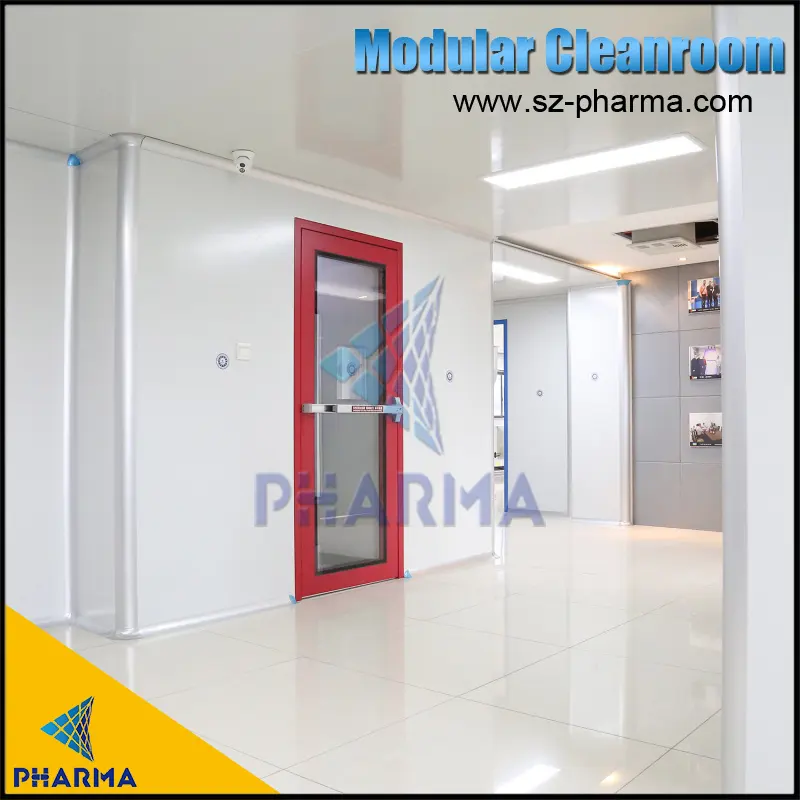
A surface itself can be a source of contamination if it harbors microbes or sheds particles. Suzhou Pharma’s material selection is dictated by cleanability and inertness. Walls and ceilings are constructed from non-porous, monolithic panels—often high-performance coated steel or fiberglass-reinforced plastic—with fully coved, radiused corners where walls meet floors and ceilings. There are no sharp angles or ledges to collect dust. Crucially, the modular construction method, with panels fabricated and joined under controlled factory conditions, allows for near-seamless integration. Welded seams and gasketed joints are perfected in the factory, minimizing the microscopic gaps and imperfections common in field construction that can become reservoirs for contaminants. The room, in essence, is designed to have no place for contamination to hide.
Integrated Environmental Control: Precision from the Plenum Down
Contamination risk is directly governed by the quality and behavior of the air within the cleanroom. Suzhou Pharma’s design philosophy centralizes this control. Their hallmark is the fully integrated, modular ceiling plenum. This unitized system incorporates HEPA or ULPA filtration, lighting, fire suppression, and often sprinkler heads, all pre-assembled and pre-tested. This integration ensures that the most critical contamination control element—the laminar or turbulent airflow delivering hundreds of air changes per hour—is perfectly uniform and leaves no dead zones. By controlling the entire environment from the "top down" as a single, optimized system, they eliminate the performance variances and installation errors that can occur when these components are sourced and installed by separate trades.
The Human Factor: Designing for Error Reduction
Recognizing that personnel are the largest potential contamination source, the design actively mitigates human-borne risk. This goes beyond standard gowning procedures to include ergonomic and architectural features that reduce unnecessary movement and interaction with the critical zone. Pass-through hatches and rapid transfer ports (RTPs) are strategically placed to limit direct material ingress into the core. The placement of control panels, glove ports, and viewing windows is meticulously planned to allow operators to perform tasks efficiently without compromising the sterile field. The environment is designed to guide correct behavior intuitively, making it easier for staff to comply with aseptic techniques by reducing complexity and temptation for shortcuts.
A Foundation for Assured Product Protection
Ultimately, Suzhou Pharma’s design philosophy transforms the cleanroom from a passive container into an active assurance system. By proactively designing out contamination risks through zoning, flow control, seamless surfaces, and integrated environmental systems, they create a foundation of inherent cleanliness. This philosophy, executed through precision modular construction, delivers more than just a room that meets ISO classifications. It delivers a predictable, reliable, and defensible environment where the risk of microbial and particulate contamination is minimized at its source. In an industry where product integrity is paramount, this approach provides the ultimate safeguard: a facility engineered from the ground up to protect the product it was built to produce.