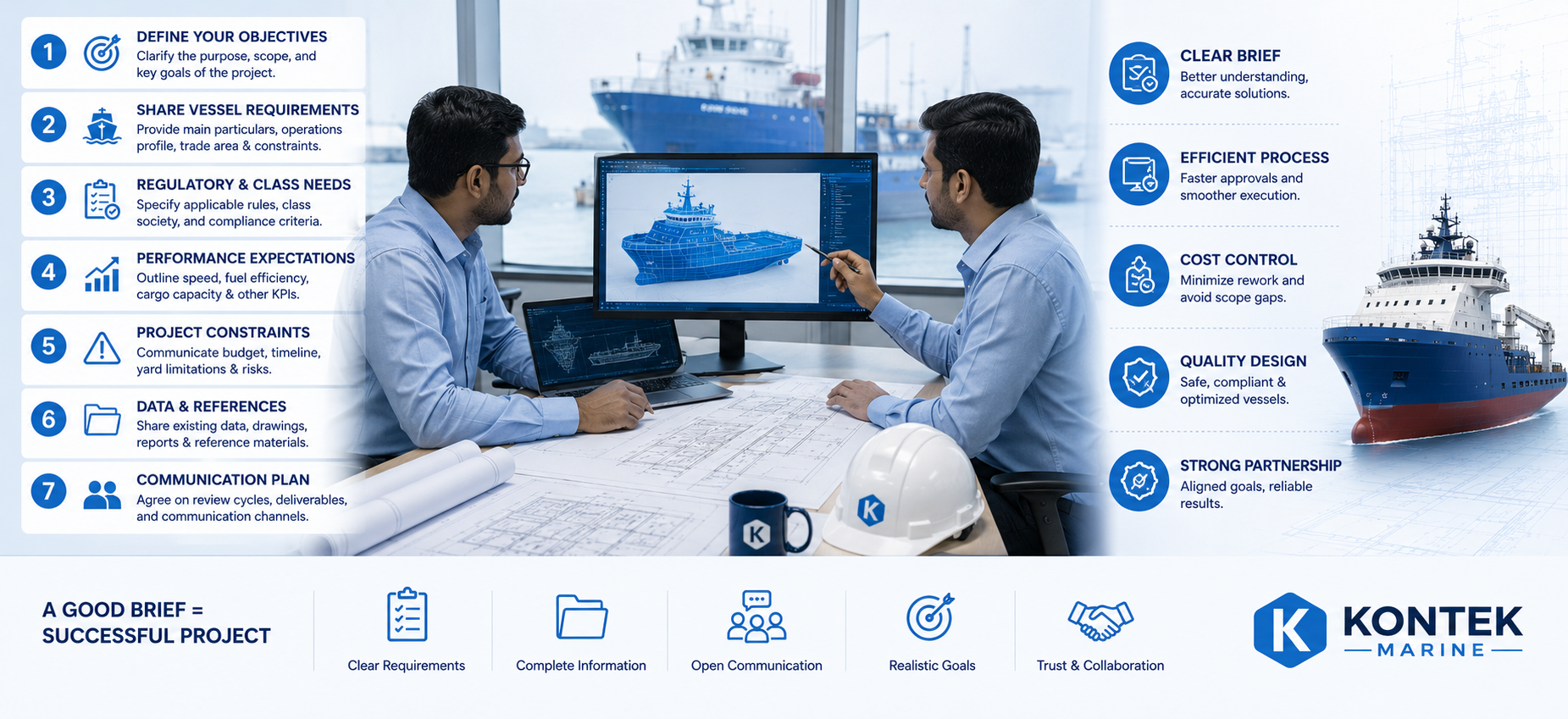
How to Brief a Marine Design Bureau & Services Company — A Practical Guide for Shipowners and Project Managers
Meta Description: Commissioning ship design work for the first time? This practical guide explains exactly what to prepare and what to ask before you sign anything.
Most Design Project Problems Start Before the Engineer Opens a Drawing
Many marine design projects that run late or over budget do so because the project brief was incomplete long before the first drawing was started. Vague scope, missing vessel information, unclear approval requirements, or unrealistic deadlines create problems that multiply as engineering progresses.
A well-prepared brief reduces revision cycles, protects the schedule, and allows the design bureau to price the work more accurately from the beginning. For shipowners and project managers, the briefing stage is not administration — it is risk control. This is especially important when working with a Marine Design Bureau & Services Company for the first time or after a difficult previous project.
For a practical example of the services involved, see Kontek Marine — Marine Design Bureau & Services Company in India .
What Information a Design Bureau Needs for a Newbuild Project
-
Vessel type and purpose: Define what the vessel will carry, where it will operate, and the operational targets — speed, range, cargo capacity, deck equipment, and passenger count. This sets the design basis for the entire project.
-
Target size and dimensions: Provide approximate LOA, beam, depth, and draft. Even early estimates help the bureau assess feasibility and determine which class rules are likely to apply.
-
Classification society and flag state: State the intended class society and flag administration. This determines the rule set, submission format, and approval pathway for the design.
-
Trading area: Specify the intended operating region. Loadline zone, ice class, NOx Tier requirements, and MARPOL applicability may all depend on where the vessel trades.
-
Propulsion preference: Indicate diesel-mechanical, diesel-electric, hybrid, or all-electric preference, plus any preferred engine brands or propulsion arrangements. Early clarity prevents redesign later.
-
Budget and timeline: Give a realistic construction budget range and target delivery date. This allows the bureau to identify scope and budget conflicts before detailed work begins.
What Information Is Needed for a Conversion or Modification Project
-
Existing drawings: Provide the GA, structural plans, machinery layout, and any other available drawings. Incomplete information is still useful if it is all that exists.
-
Current class record: Include the class approval file, previous modifications, class conditions, and outstanding recommendations. This avoids surprises during approval review.
-
Scope of modification: Describe exactly what is changing — cargo type, deck layout, propulsion system, accommodation arrangement, or new equipment installation.
-
Operational requirement after conversion: Explain what the vessel must do after modification that it cannot do now. This defines the engineering target for the conversion.
-
Target completion date: State when the vessel must return to service. This drives design scheduling, class submission timing, and shipyard coordination.
The Six Questions to Ask a Marine Design Bureau Before Commissioning
-
Who specifically will work on this project — and can I speak with that engineer?
-
Have you completed class approval for a similar vessel type before? Which society was involved and what was the outcome?
-
Is class approval management included in your scope or billed separately?
-
Will you provide a fixed-price quote or is this time-and-materials billing?
-
What do you need from me to guarantee the quoted timeline?
-
How do you handle scope changes if new information emerges during the project?
Useful technical reference
Body link only
Operators who want to understand what a classification society expects from a design submission can review Bureau Veritas's published plan-approval information through Bureau Veritas . Treat it as a technical reference resource rather than a supplier comparison.
To see how these services connect across engineering disciplines, learn more about Kontek Marine's marine services and engineering team .
What a Good Design Bureau Response to Your Brief Looks Like
-
A clear scope document: Not a generic capability statement, but a project-specific description of what will be delivered.
-
A realistic timeline: With milestones for drawing submission, class submission, and expected approval closure.
-
A fixed price — or a clearly explained variable basis: Including the change-control process if the scope evolves.
Kontek Marine provides scope, timeline, and fixed-price quote after reviewing the client brief. If the project changes, the change is communicated before additional work proceeds, which is exactly the kind of process discipline first-time commissioners should expect from a professional bureau.
Conclusion
The quality of a design project outcome depends as much on the client brief as on the technical capability of the engineering team. A precise brief reduces uncertainty, speeds approval, and protects both budget and schedule. For shipowners and project managers selecting a Marine Design Bureau & Services Company, the practical test is simple: does the bureau ask the right questions, confirm scope before starting work, and manage class approval as part of the service?
Kontek Marine's team in India follows that approach through direct engineer access, fixed-price delivery, and class-aware engineering packages designed to survive review. When you are ready to move from planning to scope definition, submit your design project brief to Kontek Marine today .
Ready to brief your vessel design project?
CTA
Kontek Marine's marine design bureau responds with a clear scope, realistic timeline, and fixed price before any work begins. Newbuilds, conversions, stability analysis, and class approval management are all handled through one coordinated process.
+91 7303620603
A-24/5, 3rd Floor, NH-19, Mohan Cooperative Industrial Estate, New Delhi, Delhi 110044, India
Marine design bureau services