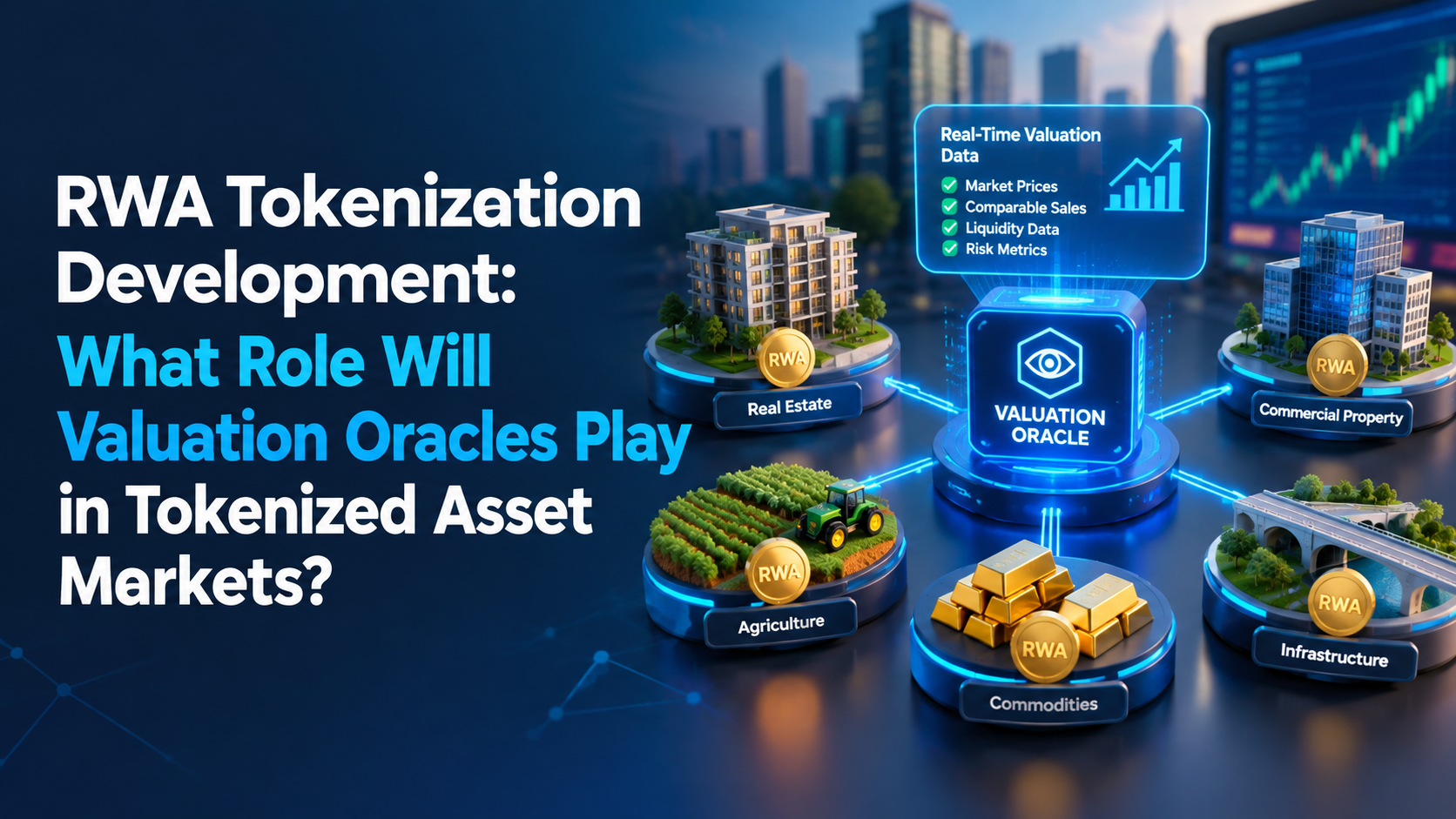
Real-world assets such as real estate, private credit, commodities, artwork, invoices, and infrastructure are increasingly being represented through blockchain-based tokens. This market model allows ownership rights, economic interests, or claims connected to physical and financial assets to be represented digitally. However, putting an asset on a blockchain does not automatically tell investors what that asset is worth today. This is where valuation oracles can become an important part of RWA tokenization development.
A valuation oracle can connect blockchain applications with external valuation information. It can bring data such as property prices, commodity rates, credit information, market indexes, appraisal reports, or other relevant indicators into a tokenized asset platform. Smart contracts can then use this information for functions such as pricing, collateral assessment, redemptions, lending, portfolio monitoring, and secondary-market activity.
As RWA tokenization continues to develop, valuation oracles may become an important data layer between off-chain assets and on-chain financial applications. Their role will not simply involve publishing a number. They may also need to address data quality, update frequency, source selection, validation, and conflicts between different valuation sources.
Why Tokenized Assets Need Reliable Valuation Data
A token can represent an interest in an asset, but its market value can change over time. Consider a property represented through digital tokens. The property may have an appraisal value at the time of issuance, but changes in rental income, occupancy, local property prices, interest rates, and market conditions can affect its value later.
Without updated valuation information, investors and platform operators may have difficulty assessing the current position of the asset. The same issue can appear with gold, private debt, carbon credits, artwork, equipment, and other real-world assets.
For an RWA tokenization company, this creates a need for reliable connections between off-chain valuation systems and blockchain applications. A valuation oracle can serve this purpose by supplying external information to smart contracts or platform interfaces.
The objective is not necessarily to produce one permanent valuation. Instead, the oracle can provide data at defined intervals or when specific events occur. This gives tokenized asset platforms a way to work with information that exists outside the blockchain.
How Valuation Oracles Work in RWA Tokenization
The basic process starts with external data sources. These may include professional appraisers, financial institutions, commodity exchanges, property databases, market indexes, accounting records, or specialized data providers.
The oracle collects information from selected sources and processes it before sending the relevant value to a blockchain network. Depending on the design, several data sources may be compared before a value is accepted.
For example, suppose a tokenized commercial property has an estimated value of $20 million. The platform may receive appraisal information, rental performance data, comparable property prices, and other market indicators. The oracle system can process these inputs and publish a valuation figure that smart contracts or platform systems can reference.
An RWA tokenization platform development project therefore needs to consider both blockchain infrastructure and external data architecture. The oracle should not be treated as an isolated feature. It forms part of the wider information flow connecting physical assets, asset managers, investors, and smart contracts.
Supporting Token Pricing
Valuation oracles may have a direct role in determining reference prices for RWA tokens. This can be useful when the underlying asset does not trade continuously.
A publicly traded security may have frequent market prices, but a commercial property may only receive a formal valuation periodically. A private credit instrument may also depend on financial information that becomes available at specific reporting intervals.
An oracle can provide a reference valuation that a platform uses when displaying token prices, calculating portfolio values, or determining certain transaction conditions. The reference value does not necessarily have to become the actual trading price. Market participants may still buy or sell tokens at prices influenced by demand, liquidity, risk, and other factors.
This distinction matters because the value of an underlying asset and the market price of its token may not always be identical.
Valuation Oracles and Tokenized Real Estate
Real estate is one of the areas where valuation oracles could have considerable practical use. Property values depend on location, property type, rental income, occupancy, financing conditions, development status, and local market activity.
A real estate tokenization platform can use valuation data to provide periodic updates for token holders. For example, an office property could receive valuation updates every quarter based on appraisal reports and market indicators.
The information could also support lending applications. If tokenized property interests are accepted as collateral, a lending protocol may need a current estimate of the underlying asset's value. The oracle can provide the valuation data required for loan-to-value calculations.
A real estate tokenization development company may therefore need to consider oracle architecture when designing property investment platforms, especially where tokens interact with lending, redemptions, portfolio reporting, or automated financial rules.
Supporting Collateral Valuation
Tokenized assets may eventually be used in digital lending markets. In such systems, valuation information becomes especially important because lenders need to assess the value of collateral.
Suppose an investor holds tokens representing an interest in a property worth $5 million. If those tokens are accepted as collateral for a loan, the lending application needs information about the property's current valuation.
A valuation oracle can send the latest approved valuation to the lending contract. The contract may then compare the collateral value with the outstanding loan amount.
If the asset value falls below a predefined threshold, the platform may initiate a margin call or another risk-management process. If the value increases, the borrowing capacity may change depending on the platform's rules.
This creates a connection between real-world valuation processes and blockchain-based financial applications.
Handling Multiple Valuation Sources
Using one data source can create dependency on that provider. If the source reports an inaccurate figure, becomes unavailable, or publishes outdated information, the tokenized asset platform may receive misleading data.
A more robust oracle model can use multiple sources. The system may compare values from different appraisers, indexes, market databases, or data providers before producing a reference figure.
For instance, a tokenized commodity platform could collect prices from several recognized market sources. A property platform could combine appraisal reports with comparable property transactions and income-based calculations.
Different asset categories may require different approaches. There is no universal valuation formula for every RWA. An RWA token development project should therefore consider the characteristics of the underlying asset when selecting its oracle model.
Frequency of Valuation Updates
Not every asset needs valuation data at the same frequency.
A commodity connected to active markets may require frequent price updates. A commercial building may receive formal valuations monthly, quarterly, or at another agreed interval. Artwork may rely on periodic appraisals and transaction evidence.
Updating data too frequently can increase operational and network costs without providing meaningful additional information. Updating it too rarely can leave investors working with outdated figures.
The appropriate frequency depends on the asset, market activity, regulatory requirements, platform design, and intended use of the token. An RWA tokenization development company can establish update rules based on these factors during platform planning.
Preventing Manipulated Valuation Data
Oracle security is an important consideration because incorrect external data can affect smart contract operations.
If a malicious party can influence the information entering an oracle, the resulting valuation could affect token prices, collateral ratios, redemptions, or other financial activities.
Several methods can reduce this risk. Platforms may use multiple independent data sources, data validation rules, trusted providers, historical comparisons, anomaly checks, and human review for certain asset classes.
For high-value assets, a combination of automated and professional valuation processes may be more appropriate than relying entirely on a single automated feed.
The oracle architecture should also record when a valuation was published, where it came from, and which methodology was used. This gives platform operators and investors a better basis for reviewing valuation changes.
Role in Secondary Markets
Secondary trading creates another use case for valuation oracles. Token holders may want to sell their positions before the underlying asset is sold.
A reference valuation can help participants understand the relationship between the token price and the underlying asset. It may also provide information for market makers, trading platforms, and portfolio systems.
However, an oracle should not dictate the trading price. The market can still determine the price through buying and selling activity.
For example, a token representing part of a private property portfolio may have an oracle-based reference value of $10 per token. Investors could trade it at $9.50 or $10.40 depending on liquidity, demand, fees, risk perceptions, and other factors.
The oracle therefore acts as an information source rather than a replacement for market activity.
Valuation Oracles and Portfolio Management
Tokenized asset platforms may contain portfolios holding multiple asset categories. Investors could own tokens linked to properties, private credit, commodities, infrastructure projects, or other assets.
Portfolio systems need valuation information to calculate the estimated value of an investor's holdings. Oracles can supply updated information for each asset and allow the platform to calculate portfolio-level figures.
For fund managers, this information can also support reporting and internal monitoring. Changes in asset valuations can be tracked over time, giving managers a view of how portfolio composition and estimated values are changing.
An RWA tokenization platform development company may therefore include oracle connections as part of portfolio dashboards, reporting systems, risk modules, and asset-management tools.
Compliance and Valuation Records
Valuation information can also have a role in regulatory and operational processes. Depending on the jurisdiction and asset type, token issuers may have reporting obligations related to asset values, investor holdings, or financial statements.
A platform can record valuation updates alongside other asset information. Each update can contain a timestamp, source reference, valuation figure, and applicable methodology.
This does not replace legal, accounting, or appraisal requirements. Instead, it provides a digital record that can support operational processes.
A Real-world asset tokenization company working with regulated financial products may need to connect oracle systems with identity checks, investor permissions, asset records, transaction histories, and reporting tools.
Challenges in Using Valuation Oracles
Despite their potential benefits, valuation oracles introduce several challenges. The first is data quality. If external information is incorrect, the oracle cannot automatically make that information accurate.
Another challenge is valuation disagreement. Two professional appraisers may produce different estimates for the same property. Commodity markets may also show different prices depending on location, exchange, timing, and contract type.
There is also the issue of stale data. A valuation that was accurate three months ago may not represent current market conditions.
Cost is another consideration. Frequent data updates, professional appraisals, multiple data providers, and validation systems can increase operating expenses.
For these reasons, RWA tokenization systems need a defined policy for data sources, update schedules, validation procedures, dispute handling, and valuation overrides.
What Future RWA Platforms May Expect From Oracles
As tokenized asset markets mature, valuation oracles may become more closely connected with lending, trading, portfolio management, insurance, treasury systems, and other blockchain applications.
Future platforms may use different oracle models for different asset categories. A property token could rely on professional appraisals and market data, while a commodity token could use frequent market prices.
There may also be greater use of historical valuation records. Instead of displaying only the latest figure, platforms could show valuation changes over time, allowing investors to compare asset performance with token activity.
For an RWA tokenization company, oracle design may therefore become part of the platform's wider financial architecture rather than a separate technical component.
How Businesses Can Plan Oracle Integration
Businesses planning an RWA tokenization project should begin by identifying what information the smart contracts actually need. Not every tokenized asset requires continuous valuation data.
The next step is selecting suitable data providers and determining how frequently information should be updated. Businesses should also decide whether one source is sufficient or whether multiple sources should be combined.
The platform should then define rules for unusual situations, such as missing data, conflicting valuations, delayed updates, or major market movements.
These decisions can be included during RWA tokenization platform development rather than added after the platform is launched. Doing so allows the oracle system to work with the token contracts, investor dashboard, asset-management system, and other platform components from the beginning.
Why Valuation Oracles Matter to RWA Tokenization Development
The success of tokenized asset markets depends on more than issuing digital tokens. Investors and financial applications need dependable information about the assets represented by those tokens.
Valuation oracles can provide a connection between real-world valuation processes and blockchain applications. They can support token pricing, collateral calculations, portfolio reporting, secondary-market information, and other financial activities.
For businesses working with RWA tokenization development, the main consideration is not simply whether an oracle should be added. The more important question is how valuation data should enter the platform, how it should be checked, and how smart contracts should respond to changes.
An RWA tokenization platform development company can design these processes around the asset category, business model, regulatory environment, and intended investor experience. As more assets move into blockchain-based markets, dependable valuation information may become an increasingly important part of the infrastructure connecting physical assets with digital finance.
Conclusion
Valuation oracles can play an important role in tokenized asset markets by connecting real-world valuation information with blockchain applications that need updated asset data. From property and commodities to private credit and infrastructure, different assets require different valuation methods, data sources, and update schedules. When designed carefully, oracle systems can support pricing references, collateral calculations, portfolio reporting, lending applications, and secondary-market information while keeping the valuation process connected to real-world data. Businesses entering RWA tokenization should therefore consider oracle architecture alongside token design, smart contracts, asset management, compliance, and investor systems. Blockchain App Factory provides RWA tokenization development services for businesses looking to create blockchain-based solutions for tokenized real-world assets.
FAQs
1. What is a valuation oracle in RWA tokenization?
A valuation oracle is a system that brings external asset valuation information into blockchain applications. It can provide data such as property values, commodity prices, market indexes, or other asset-related figures for use by smart contracts and platform systems.
2. Why are valuation oracles important for tokenized assets?
Tokenized assets can represent assets whose values change over time. Valuation oracles can provide updated information that supports pricing references, collateral calculations, portfolio management, lending, and other platform functions.
3. Can valuation oracles determine the trading price of an RWA token?
Not necessarily. An oracle generally provides a reference value. The actual token trading price can be influenced by demand, supply, liquidity, fees, market conditions, and investor expectations.
4. How often should tokenized assets receive valuation updates?
The frequency depends on the asset. Actively traded commodities may need frequent updates, while real estate and some private assets may use monthly, quarterly, or event-based valuations.
5. Can multiple data sources be used by an RWA valuation oracle?
Yes. A platform can use several valuation sources and compare or aggregate their information. This approach can reduce dependence on a single source and provide additional data for validation.
6. What happens if two valuation sources provide different values?
The platform can use predefined rules for handling differences. These may include weighted averages, source rankings, additional verification, professional review, or temporary suspension of automated actions.
7. How can valuation oracles support tokenized real estate?
They can provide property valuation data for portfolio reporting, token reference prices, collateral calculations, lending applications, and other platform functions connected with tokenized properties.
8. What should businesses consider before integrating a valuation oracle?
Businesses should evaluate data sources, valuation methodology, update frequency, validation rules, security, costs, asset type, regulatory requirements, and how smart contracts will respond to valuation changes.
9. What is the role of an RWA token development company in oracle integration?
An RWA token development company can design the connection between external valuation providers, oracle systems, smart contracts, asset records, and platform applications according to the project's technical and business requirements.
10. Will valuation oracles become more important as RWA markets grow?
Their importance may increase as tokenized assets become connected with lending, trading, portfolio management, and other financial applications that require current information about underlying assets.