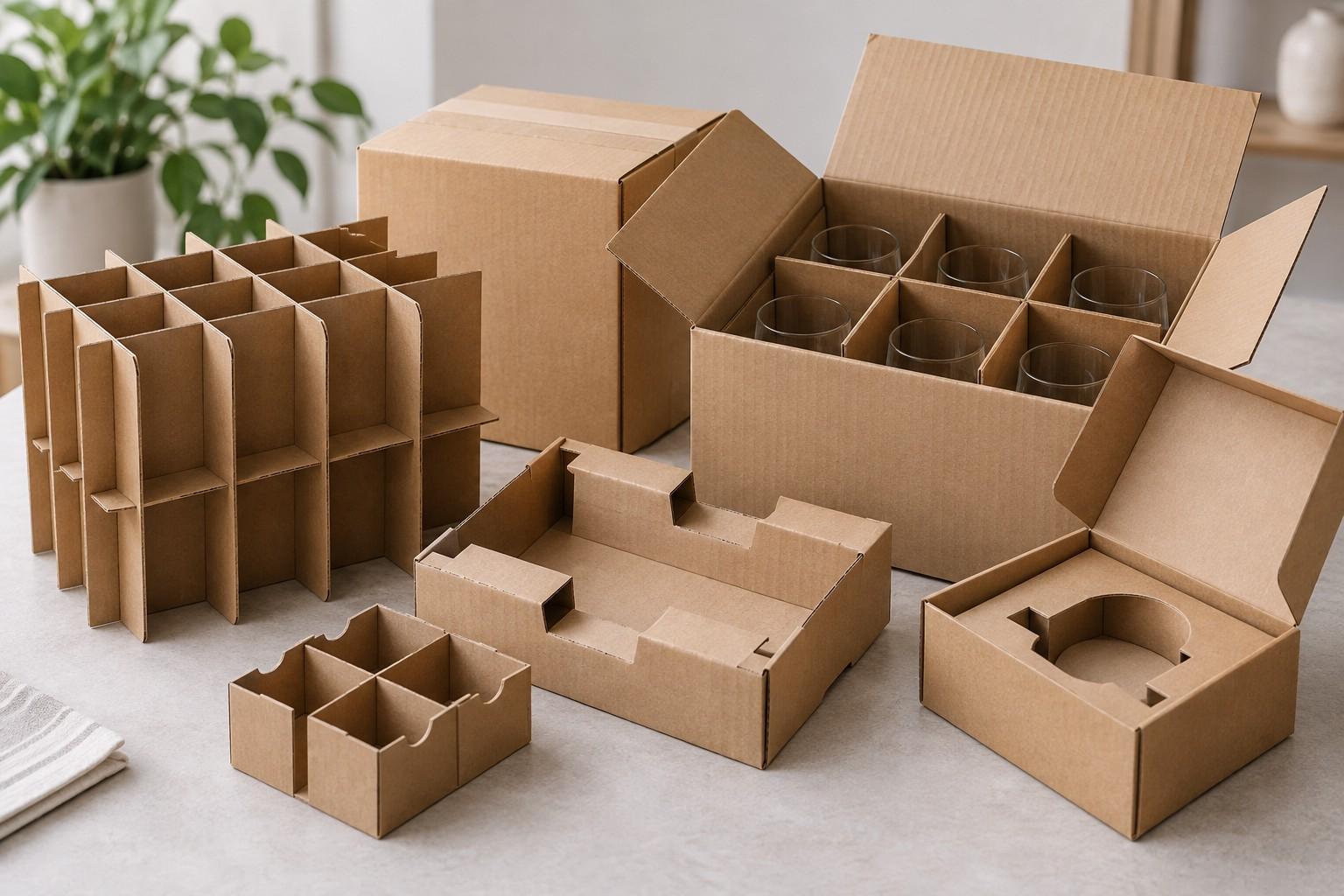
How to Choose Packaging Inserts for Irregularly Shaped Products
Irregularly shaped products are difficult to package because they rarely sit evenly inside a standard box. Handles, curved surfaces, protruding caps, uneven weight distribution, or multiple components can create empty spaces that allow movement during handling. A suitable insert helps manage those spaces by supporting the product at planned contact points instead of relying only on loose filler.
Businesses comparing different insert structures can review common material options through Inserts Hub. Foam, cardboard, corrugated board, molded pulp, and other insert types can all be useful, but the best choice depends on the product geometry, weight, surface sensitivity, shipping method, and the amount of clearance required inside the outer package.
Why Irregular Shapes Need a Different Packaging Approach
Packaging is easiest when a product has flat sides and predictable dimensions. A rectangular item can often be measured with length, width, and height alone.
Irregular products may need additional measurements because their widest point, narrowest point, center of gravity, or fragile protrusions can be located in different areas.
Examples include bottles with pumps, tools with handles, electronic devices with attached accessories, glassware with uneven profiles, cosmetic containers with decorative lids, and kits that combine several unrelated components.
In these situations, the insert needs to control movement without placing unnecessary pressure on weak or delicate areas.
Start With the Product, Not the Box
A common packaging mistake is choosing the outer box first and then trying to make the product fit the remaining space.
For irregularly shaped items, it is usually more practical to begin with the product itself. The item should be measured and its key support areas identified before the insert and outer box dimensions are finalized.
This approach makes it easier to determine how much space is actually needed and where the product requires support.
Important Measurements to Record
Before designing the insert, consider recording:
- Overall product length, width, and height
- Widest and narrowest points
- Height of caps, lids, handles, or raised features
- Product weight
- Approximate center of gravity
- Areas that should not carry pressure
- Interior dimensions of the intended outer box
- Number of products or accessories in the package
When several products share one box, their position relative to one another should also be considered.
Choose Support Points Carefully
An insert does not always need to touch every surface of a product.
In many cases, supporting a few stable areas while leaving clearance around sensitive sections can provide a more practical fit.
This is particularly important for products that contain:
- Switches
- Nozzles
- Printed finishes
- Polished surfaces
- Decorative components
- Fragile edges
- Raised controls
Support points should be located where the product can safely tolerate contact.
If too much pressure is concentrated on a weak feature, the insert itself may cause damage rather than prevent it.
The objective is to distribute support across stronger areas of the product.
Comparing Common Insert Materials
Different materials provide different forms of support.
| Material | Best Use | Main Strength | Watch For |
|---|---|---|---|
| Foam | Fragile or high-value products | Close-fitting cushioning | Overly tight cavities |
| Cardboard | Lightweight products and kits | Simple folded organization | Limited cushioning |
| Corrugated Board | Heavier items and dividers | Structural strength | Bulkier construction |
| Molded Pulp | Repeatable formed trays | Defined product positioning | Shape and tooling limitations |
No single material is automatically the best choice for every irregular product.
Material selection should follow the actual product requirements rather than a general preference for one insert type.
Foam for Complex Cavities
Foam is useful when an insert needs to follow a complicated outline or provide cushioning around fragile areas.
Custom cavities can be created around bottles, tools, electronic devices, equipment, and mixed product kits containing components of different shapes.
The cavity should hold the product securely without creating excessive compression.
Some clearance may be necessary around delicate buttons, edges, labels, or finished surfaces.
Foam Density Also Matters
Foam density should be considered along with cavity dimensions.
A very soft foam may compress too much under a heavy product. On the other hand, extremely firm foam may transfer more pressure to sensitive sections.
The correct density depends on factors such as product weight, fragility, and the amount of cushioning required.
Cardboard Inserts for Lightweight Products
Folded cardboard structures can work well when the main requirement is positioning rather than heavy cushioning.
Tabs, bridges, platforms, and partitions can create simple support points around an irregular product without filling every empty space.
Cardboard inserts are often suitable for:
- Cosmetics
- Lightweight retail items
- Food products
- Accessories
- Promotional kits
- Small product sets
A simple folded structure can sometimes provide enough support without requiring a complex cavity.
Corrugated Structures for Heavier Products
Corrugated board is better suited to heavier items or packages that require stronger internal walls.
Its fluted construction provides rigidity while allowing the insert to remain relatively lightweight.
Corrugated inserts can also separate several irregularly shaped products inside the same shipping box.
This can be useful for bottles, jars, industrial components, and other heavier goods.
Using Corrugated Dividers
Dividers can create separate sections for multiple products.
This helps limit direct contact between items and keeps each product within a planned area.
The thickness and flute type should match the weight and dimensions of the products.
Molded Pulp for Repeatable Product Positions
Molded pulp can create shaped trays around products with curved or uneven profiles.
This can be useful when the same product is packed repeatedly and consistent positioning is important.
A molded structure may support a product at several points while leaving clearance around other areas.
Typical applications can include:
- Bottles
- Electronics
- Personal care products
- Accessories
- Consumer goods
However, very fine details or narrow undercuts may require a different insert material or a simplified cavity design.
Allow Enough Clearance for Packing and Removal
A perfectly tight fit is not always the best fit.
Products need enough clearance to be inserted and removed without excessive force.
This becomes particularly important when products have:
- Glossy finishes
- Fragile labels
- Soft coatings
- Decorative surfaces
- Components that can catch on the insert
The correct amount of clearance depends partly on the insert material.
Foam can flex during packing, while rigid paperboard or corrugated structures require more deliberate spacing.
Physical samples are useful because they show whether the product feels secure during real handling rather than only appearing correct in a digital design.
Manage Uneven Weight Distribution
Irregular products often have uneven weight.
For example, a bottle may be heavier at its base, a tool may have a dense metal head, or an electronic device may contain a battery on one side.
If the insert supports only the lighter part of the product, the item may rotate or tilt during transportation.
Heavier areas should receive appropriate support.
The insert should also resist the product shifting toward unused space.
When possible, the product orientation should place its center of gravity in a stable position inside the package.
Plan for Accessories and Secondary Components
Packaging becomes more complicated when the box contains accessories along with the main product.
These may include:
- Cables
- Instruction cards
- Applicators
- Replacement parts
- Small tools
- Samples
- Chargers
- Additional components
Leaving these items loose around the main product can cause scratches, movement, or poor organization.
Separate compartments can keep smaller components away from sensitive surfaces.
Small items may use shallow pockets, folded sections, or dedicated cavities.
The layout should also make each component easy to identify when the package is opened.
Consider the Outer Box Dimensions
The insert and outer box should be designed as one system.
An insert may fit the product correctly but still move if the outer box is significantly larger than the insert.
Likewise, a properly sized outer box cannot compensate for an insert that allows the product to rotate or collide with other components.
The relationship between the product, insert, and box should therefore be checked before final production.
Test the Complete Package
Whenever possible, a sample insert should be tested inside the actual outer box using the real product.
Testing allows the packaging team to check:
- Product movement
- Pressure points
- Ease of packing
- Ease of removal
- Insert stability
- Accessory movement
- Product orientation
It is also useful to gently tilt and handle the closed package to see whether the product moves inside.
The test should focus on the complete packaging system rather than evaluating the insert alone.
Questions to Ask Before Finalizing the Insert
Before approving an insert design, consider these questions:
- Does the product move when the closed box is gently tilted?
- Are fragile features free from unnecessary pressure?
- Can the product be packed without excessive force?
- Can the product be removed easily?
- Does the insert remain stable inside the outer box?
- Are heavier areas properly supported?
- Are accessories separated from sensitive surfaces?
- Does the material match the expected shipping conditions?
- Is there unnecessary empty space inside the box?
- Can the same packing arrangement be repeated consistently?
Answering these questions can help identify problems before larger quantities are produced.
A Practical Way to Select the Right Structure
For irregularly shaped products, insert selection can follow a simple sequence.
First, understand the complete product geometry. Next, identify stable areas that can safely support the product. Then choose an insert material based on weight, fragility, and the amount of cushioning or structural support required.
After that, allow enough clearance for practical packing and removal. Confirm that the insert fits correctly inside the outer box, and test the complete package using the actual product whenever possible.
This process can help avoid excessive filler and prevent overly complicated insert designs that do not address the real packaging problem.
A practical insert controls movement where necessary while keeping the packing process consistent and repeatable.