Introduction
Some games greet you with a tutorial, a map, and a friendly voice telling you exactly where to go. This one does none of that. It drops a small square at the edge of the screen, starts the music, and dares you to keep up. If you press nothing, you die. Press too early, you die. Press a fraction of a second too late, you die — and the level restarts before you have finished reacting.
That sounds miserable on paper, and for the first ten minutes it sort of is. Then something clicks. You stop seeing a wall of spikes and start hearing a rhythm. Your thumb moves before your brain finishes the thought. That moment — when a stage that made you want to close the tab finally bends to your timing — is the whole reason this game has such a stubborn, loyal audience.
This piece is for anyone curious about Geometry Dash but unsure where to begin, or for someone who keeps bouncing off it and wants to understand what everyone else seems to get. No world records, no showing off — just how the game works and how to enjoy it on your own terms.
Gameplay: What You Are Actually Doing
The core is almost embarrassingly simple. Your character moves forward automatically, and you control exactly one thing: whether it jumps. A quick tap makes you hop. A long hold keeps you in the air for as long as you stay up, which matters far more than beginners expect — plenty of obstacles are cleared by holding, not tapping.
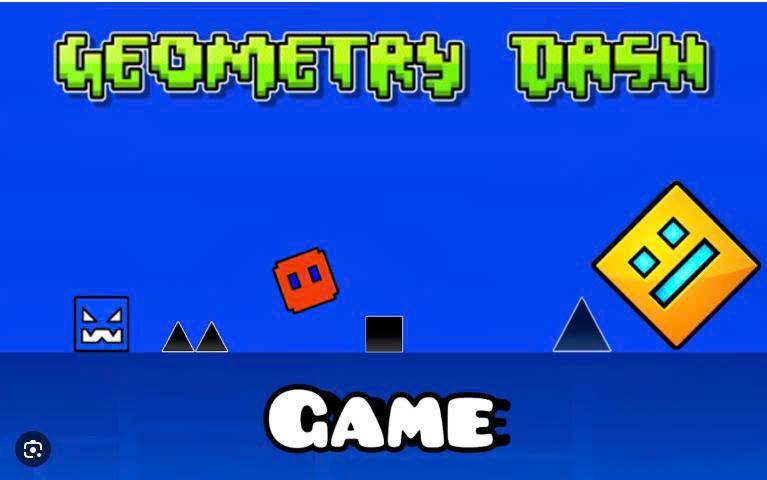
That is it. Everything the game throws at you is built from that single input. Spikes and blocks end your run on contact. Yellow pads launch you, rings give you a mid-air jump, portals flip your gravity or change your shape — a cube becomes a ship, a ball, a UFO, a wave. Each form changes the feel without adding new buttons, which is a clever trick: difficulty scales, but the controls never get more complicated. The only moving part is your timing.
Levels are short, usually under two minutes, but they must be cleared in one unbroken run from start to finish. There is no mid-level save point. That is the source of the game's famous "just one more try" loop, and also the reason a two-minute stage can eat an entire evening.
Every official level also hides three secret coins. Collecting them is optional, but they are a nice excuse to revisit stages you assumed you had mastered. And once the built-in levels run out, the community editor has produced tens of thousands more, from gentle warm-ups to genuinely absurd challenges.
Tips for Getting Better Without Burning Out
Play with sound on. This is not decoration, it is the actual strategy. Obstacles are placed to match the beat, so the music effectively announces what is coming. Headphones and a steady volume help more than any trick.
Treat Practice Mode as a study tool, not a crutch. Practice Mode adds checkpoints so you can learn a brutal section, and you can even drop your own. The trap is living there forever. Learn the pattern, then commit to the full run.
Break levels into chunks. Instead of restarting from zero every attempt, isolate the parts that kill you and drill those. Ten repetitions of a five-second segment teaches you more than ten complete attempts.
Accept that failure is the format. You will die hundreds of times on a stage other players call easy. That is normal. Progress here is not measured by finishing; it is measured by reaching further than last time.
Watch someone else's run. Seeing a level completed is oddly motivating, and it reveals the intended rhythm of the tricky sections.
Take breaks, especially when you are angry. Frustrated hands miss timings they would hit while calm. A tilted player is not a bad player.
Start easier than your ego wants. The difficulty faces in the level list are not decoration. Jumping straight into an Extreme Demon as your third stage is a fast route to quitting.
Press, do not mash. Panicking and spamming taps usually makes things worse. If a section feels impossible, you are almost certainly misreading the timing rather than lacking speed.
Conclusion
Geometry Dash is, at heart, a game about patience dressed up as a game about reflexes. It looks twitchy and punishing from the outside, and it can be both — but the real skill is quieter than that. It is learning a pattern, holding it in your head, and staying calm enough to execute it.
You do not need to chase a completion percentage or measure yourself against the names on the leaderboards. Beat a stage that once felt impossible. Grab one coin you kept missing. Learn a song well enough that your hands move on their own. Those small wins are the actual reward, and they are available to anyone willing to press a single button a few hundred times.