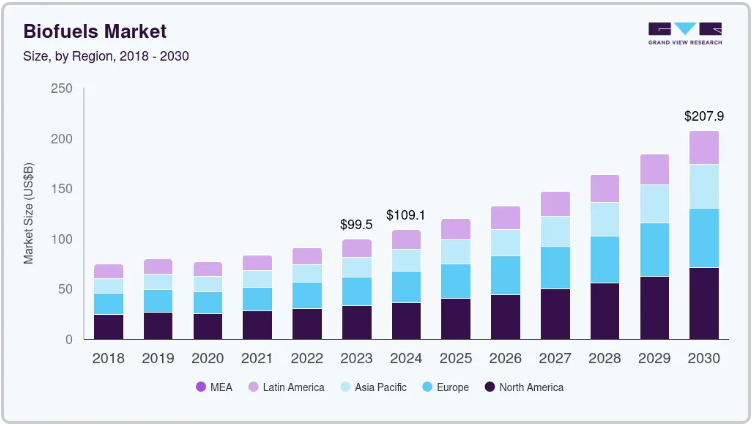
Biofuels offer a pathway to diversify energy supplies and reduce dependence on conventional petroleum fuels. Yet their long-term expansion depends on resolving a fundamental challenge: renewable fuels must become more commercially competitive while maintaining sustainable feedstock supplies. Production costs, conversion efficiency, food-security concerns, and engine performance can influence adoption even as regulations and emissions-reduction goals support demand. These opposing forces are shaping the biofuels market, projected to grow at a CAGR of 11.3% from 2024 to 2030.
Key Highlights
The Biofuels Market was valued at USD 99.5 billion in 2023 and is forecast to reach USD 207.9 billion by 2030, including USD 132.7 billion in 2026. North America held a 33.0% revenue share in 2023, and Asia Pacific is expected to grow fastest. Transportation contributed more than 71.0% of revenue, liquid biofuels held over 43.0%, and the others feedstock category accounted for more than 47.0%.
The Opportunity: Reducing Dependence on Fossil Fuels
Biofuels can be produced from plants, animal waste, and algae. Their renewable feedstocks can be replenished, offering an alternative to finite fossil fuel resources. Government support, tax incentives, fuel-blending policies, and growing awareness of carbon emissions are encouraging their use.
Transportation is the largest application, representing more than 71.0% of revenue in 2023. Liquid biofuels can be blended with conventional fuels and used through existing distribution infrastructure with relatively minor modifications.
The Barrier: Production Cost and Energy Efficiency
Biofuel production can be more expensive than conventional fuel production, and the energy gained from certain pathways may be lower. The supplied report gives an energy return on investment of 5.5 for soybean biodiesel compared with 16 for petroleum-based fuels.
Want to Understand What’s Driving Market Growth? Ask Prism AI for research-backed insights into market size, evolving opportunities
Biodiesel can also have lower energy content than petroleum diesel, affecting fuel efficiency and potentially engine performance. These limitations can reduce its attractiveness when fuel costs and performance are major purchasing considerations.
The commercial scaling challenge follows this sequence:
Feedstock Sourcing → Conversion and Processing Costs → Fuel Yield and Energy Efficiency → Final Fuel Price → Adoption and Market Scale
Improving the economics at each stage is important for sustained expansion.
The Feedstock Dilemma: Renewable Does Not Always Mean Conflict-Free
Corn, sugarcane, soybeans, and oil palms can serve as biofuel feedstocks. However, using food crops at large scale can increase competition between fuel production and food supply, potentially affecting prices and food security.
Agricultural residues such as rice straw offer another option. The market's others feedstock category, which includes rice, wheat, and potatoes, accounted for more than 47.0% of revenue in 2023.
Microalgae also attract research interest due to their rapid growth potential, energy content, and carbon dioxide fixation capacity. Their commercial viability still depends on higher yields and more cost-effective production processes.
Download a free sample report or claim your copy of this full market intelligence report
The Opportunity: Aviation and Alternative Applications
Aviation is expected to record the fastest CAGR among applications from 2024 to 2030. Emissions-reduction initiatives, including CORSIA, are supporting interest in alternative aviation fuels.
Liquid biofuels are projected to grow at a CAGR of 11.5%, supported by transportation demand and ethanol-blending programs. Gaseous biofuels also offer applications in transportation, electricity generation, and cooking.
Regional Markets Offer Different Growth Conditions
North America accounted for 33.0% of global revenue in 2023. The U.S. represented more than 96.32% of the region's market, supported by policies, incentives, infrastructure, and investment in advanced biofuels. Canada is projected to grow at 11.7% CAGR from 2024 to 2030.
Asia Pacific is expected to be the fastest-growing region, with India holding more than 13.35% of the global market in 2023 and China expected to expand significantly. Europe is investing in biofuel refineries and non-food feedstock research. Germany accounted for over 18.8% of the European market, while Spain is projected to grow at 12.4% CAGR.
Brazil represented 84.38% of Central and South America's market in 2023. The Middle East and Africa region is projected to grow at a CAGR of 9.5%.
What Will Determine Future Growth?
The biofuels market has strong demand drivers, but its development will depend on how effectively the industry addresses cost, efficiency, and feedstock constraints. Improved conversion technology, greater use of agricultural residues, expanded aviation applications, and supportive policy frameworks can create opportunities.
The most sustainable growth pathway will require biofuels to become more competitive without increasing pressure on food resources or compromising fuel performance.
Grand View Signal: Understand the Factors Shaping Commodity Prices – Explore the Platform