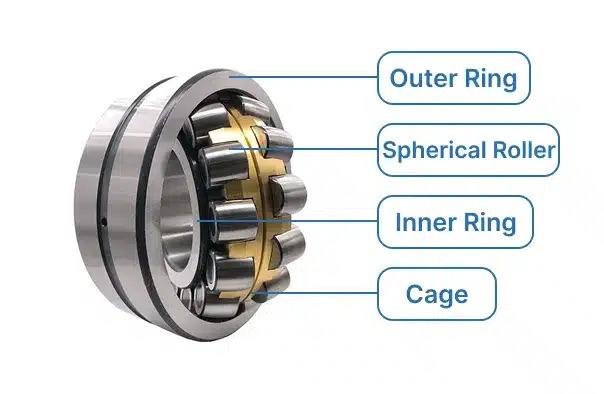
A spherical roller bearing is a heavy-duty bearing designed to support high radial loads while accommodating shaft misalignment. It uses barrel-shaped rollers and a curved outer raceway to allow rotating machinery to operate smoothly under demanding conditions.
These bearings are widely used in mining equipment, conveyors, crushers, steel mills, and industrial machinery. Their design makes them suitable for applications involving heavy loads, vibration, and shaft deflection.
What Is a Spherical Roller Bearing?
A spherical roller bearing is a rolling element bearing that supports rotating shafts while allowing limited angular misalignment between the shaft and housing.
Most standard designs contain two rows of barrel-shaped rollers positioned between an inner ring and a spherical outer raceway.
The main components include:
-
Inner ring: Fits onto the rotating shaft.
-
Outer ring: Contains the curved raceway.
-
Rollers: Carry radial and axial loads.
-
Cage: Keeps the rollers properly spaced.
-
Guide components: Help control roller movement in certain designs.
This construction provides high load capacity while helping accommodate alignment errors.
How Does a Spherical Roller Bearing Work?
When a shaft rotates, the rollers move along the bearing raceways and transfer loads between the inner and outer rings.
The spherical outer raceway allows the inner ring and roller assembly to tilt slightly relative to the outer ring.
This self-aligning feature helps accommodate shaft deflection and mounting inaccuracies.
Spherical roller bearings primarily support radial loads but can also handle axial loads in both directions, depending on their design and operating conditions.
What Are the Main Types of Spherical Roller Bearings?
Different industrial applications require different bearing configurations.
Open Spherical Roller Bearings
Open bearings allow lubricant to reach the rolling elements through the machine's lubrication system.
They are commonly used in industrial gearboxes, conveyors, and heavy machinery.
Sealed Spherical Roller Bearings
Sealed bearings include protective seals that help retain grease and reduce contamination.
They are useful in dusty or wet environments where additional protection is needed.
Split Spherical Roller Bearings
Split bearings are designed to simplify installation and replacement in difficult-to-access equipment.
They are often used where removing the shaft or surrounding machinery would be time-consuming.
Tapered Bore Spherical Roller Bearings
Tapered bore bearings can be mounted using suitable adapter or withdrawal sleeves.
They are commonly used in industrial shaft arrangements requiring this mounting method.
Where Are Spherical Roller Bearings Used?
Spherical roller bearings are widely used in industries where equipment operates under heavy loads and challenging conditions.
Mining equipment: Support rotating components in crushers, conveyors, and suitable vibrating machinery.
Steel mills: Used in machinery exposed to high loads and demanding operating conditions.
Paper mills: Support rollers and processing equipment.
Industrial gearboxes: Help support rotating shafts carrying substantial radial loads.
Agricultural machinery: Used in equipment exposed to changing loads and environmental conditions.
Power generation: Found in selected wind turbine and industrial power equipment applications.
What Are the Benefits of Spherical Roller Bearings?
Spherical roller bearings offer several advantages for heavy-duty machinery.
-
High load capacity: Support substantial radial loads.
-
Self-aligning design: Accommodate limited angular misalignment.
-
Axial load support: Handle axial forces in both directions within design limits.
-
Durable construction: Suitable for demanding industrial environments.
-
Smooth rotation: Reduce friction through rolling contact.
-
Versatile applications: Available in different sizes and mounting configurations.
Their performance depends on correct installation, lubrication, and operating conditions.
How Do You Choose the Right Spherical Roller Bearing?
Choosing the correct bearing requires understanding the machine's operating requirements.
Check the Bearing Dimensions
Confirm the inner diameter, outer diameter, and width.
The bearing must match the shaft, housing, and installation space.
Understand the Load Requirements
Determine the expected radial and axial loads.
Review the bearing's dynamic and static load ratings before selecting a model.
Consider Operating Speed
Different bearing designs have different speed limitations.
Choose a model suitable for the required speed, load, and lubrication conditions.
Check Misalignment Requirements
Spherical roller bearings can accommodate limited angular misalignment.
The allowable angle depends on the bearing design and operating conditions.
Select the Correct Lubrication
Use suitable grease or oil based on temperature, speed, load, and manufacturer recommendations.
How Do You Maintain Spherical Roller Bearings?
Proper maintenance helps extend bearing service life and reduce unexpected equipment problems.
-
Use the recommended lubricant.
-
Keep bearings protected from dust and moisture.
-
Monitor unusual vibration and noise.
-
Avoid excessive loads and operating speeds.
-
Check shaft alignment and mounting conditions.
-
Inspect bearings during scheduled maintenance.
-
Replace damaged bearings when necessary.
Always follow the equipment manufacturer's maintenance instructions.
Why Choose TFL Bearing?
TFL Bearing offers spherical roller bearing solutions for industrial machinery, mining equipment, manufacturing systems, and other heavy-duty applications.
Customers can explore different bearing sizes, configurations, and specifications to find suitable products for their equipment.
Visit TFL Bearing to explore available bearing products and request product information.
For replacement or bulk purchasing requirements, provide the bearing model number, dimensions, operating conditions, and required quantity.
Frequently Asked Questions
What Is a Spherical Roller Bearing Used For?
It supports heavy radial loads, accommodates limited shaft misalignment, and helps rotating machinery operate reliably.
Can Spherical Roller Bearings Handle Axial Loads?
Yes. Most standard double-row spherical roller bearings can support axial loads in both directions within their design limits.
Are Spherical Roller Bearings Self-Aligning?
Yes. Their spherical outer raceway allows limited angular movement between the inner and outer rings.
What Causes Spherical Roller Bearing Failure?
Common causes include poor lubrication, contamination, incorrect installation, excessive loading, and unsuitable operating conditions.
How Long Does a Spherical Roller Bearing Last?
Bearing life depends on load, speed, lubrication, installation quality, and working conditions.
Conclusion
Spherical roller bearings are important components in heavy industrial machinery. Their high radial load capacity and self-aligning design make them suitable for demanding applications.
Understanding bearing types, load ratings, installation requirements, and maintenance practices helps buyers choose the right product. TFL Bearing offers spherical roller bearing solutions for a wide range of industrial needs.